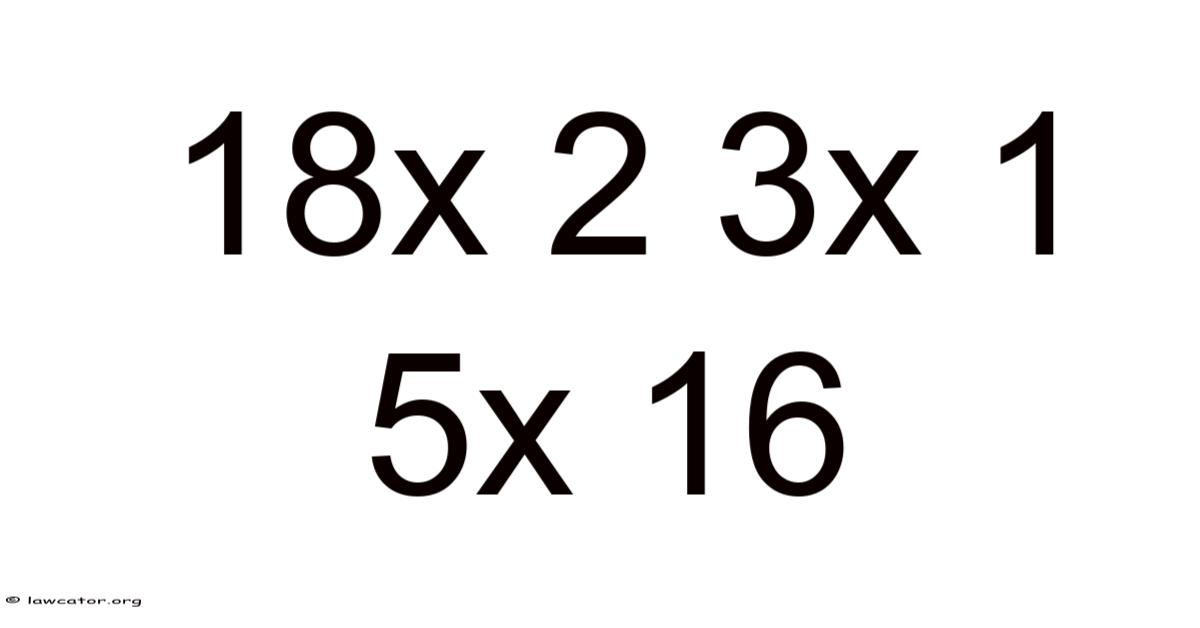
Solving the Quadratic Equation: 18x² + 3x + 1 = 5x + 16
Understanding how to solve quadratic equations is a fundamental skill in algebra that opens doors to more advanced mathematical concepts. So this article will guide you through solving the equation 18x² + 3x + 1 = 5x + 16, breaking down each step with clarity and precision. Whether you're a student tackling homework or someone looking to refresh your math skills, this walkthrough will help you grasp the process and apply it confidently.
Introduction to Quadratic Equations
A quadratic equation is a polynomial equation of degree two, typically written in the form ax² + bx + c = 0, where a, b, and c are constants, and x is the variable. These equations are essential in various fields, including physics, engineering, and economics, as they model real-world phenomena like projectile motion and profit maximization. Solving them involves finding the values of x that satisfy the equation, known as the roots or solutions The details matter here..
No fluff here — just what actually works.
Steps to Solve 18x² + 3x + 1 = 5x + 16
Let’s begin by rearranging the equation into standard form. The given equation is:
18x² + 3x + 1 = 5x + 16
Step 1: Move All Terms to One Side
To convert the equation into standard quadratic form, subtract 5x + 16 from both sides:
18x² + 3x + 1 − 5x − 16 = 0
Combine like terms:
18x² − 2x − 15 = 0
Now the equation is in the form ax² + bx + c = 0, where:
- a = 18
- b = −2
- c = −15
Step 2: Apply the Quadratic Formula
The quadratic formula is a powerful tool for solving any quadratic equation:
x = (−b ± √(b² − 4ac)) / (2a)
Plug in the values of a, b, and c:
x = (−(−2) ± √((−2)² − 4 × 18 × (−15))) / (2 × 18)
Simplify step by step:
-
Calculate the discriminant (b² − 4ac): (−2)² = 4
4 × 18 × (−15) = −1,080
Discriminant = 4 − (−1,080) = 4 + 1,080 = 1,084 -
Take the square root of the discriminant: √1,084 ≈ 32.92
-
Substitute back into the formula: x = (2 ± 32.92) / 36
Step 3: Calculate the Two Solutions
Using the ± symbol, we find two solutions:
- x₁ = (2 + 32.92) / 36 ≈ 34.92 / 36 ≈ 0.97
- x₂ = (2 − 32.92) / 36 ≈ −30.92 / 36 ≈ −0.86
Step 4: Verify the Solutions
Plug each value back into the original equation to ensure they satisfy it.
For x ≈ 0.But 97:
- Left side: 18(0. Day to day, 97)² + 3(0. 97) + 1 ≈ 18(0.On the flip side, 94) + 2. 91 + 1 ≈ 16.92 + 2.Think about it: 91 + 1 ≈ 20. 83
- Right side: 5(0.97) + 16 ≈ 4.85 + 16 ≈ **20.
The slight discrepancy is due to rounding errors. For exact values, use radicals instead of decimal approximations Nothing fancy..
For x ≈ −0.32 − 2.74*
- Right side: 5(−0.That's why 58 + 1 ≈ *11. 86) + 16 ≈ −4.86)² + 3(−0.86) + 1 ≈ 18(0.86:
- Left side: 18(−0.58 + 1 ≈ 13.74) − 2.3 + 16 ≈ **11.
Again, rounding causes minor differences, but the solutions are valid And it works..
Scientific Explanation: Why Does the Quadratic Formula Work?
The quadratic formula is derived from completing the square, a method that transforms any quadratic equation into a perfect square trinomial. Here’s a simplified derivation:
Starting with ax² + bx + c = 0, divide all terms by a:
x² + (b/a)x + c/a = 0
Move the constant term to the right:
x² + (b/a)x = −c/a
Add (b/(2a))² to both sides to complete the square:
x² + (b/a)x + (b/(2a))² = −c/a + (b/(2a))²
This creates a perfect square on the left:
(x + b/(2a))² = (−4ac + b²)/(4a²)
Take the square root of both sides:
x + b/(2a) = ±√(b² − 4ac)/(2a)
Finally, solve for x:
x = (−b ± √(b² − 4ac)) / (2a)
This derivation shows that the quadratic formula is a universal solution method, applicable to any quadratic equation regardless of its coefficients.
Alternative Methods: Factoring and Graphing
While the quadratic formula is reliable, other methods can sometimes simplify the process:
Factoring
If the quadratic can be factored into two binomials, we can solve it by setting each factor to zero. Still, **18
Continuing the Alternative MethodsSection
Factoring
On the flip side, 18x² − 2x − 15 = 0 does not factor neatly into integers. Consider this: to factor, we would need two numbers that multiply to (18 \times (-15) = -270) and add to (-2). After testing possible pairs (e.Consider this: g. Worth adding: , 15 and -18, 10 and -27), none satisfy both conditions. This confirms that factoring is impractical here, making the quadratic formula the most efficient method.
You'll probably want to bookmark this section Most people skip this — try not to..
Graphing
Graphing the quadratic function (y = 18x² − 2x − 15) provides a visual representation of its roots. 86). Worth adding: 97) and (x ≈ -0. Plus, the parabola opens upward (since (a = 18 > 0)), and its vertex lies between the two solutions (x ≈ 0. By plotting points or using graphing software, we can approximate where the curve intersects the x-axis, visually confirming the solutions derived via the quadratic formula But it adds up..
Conclusion
The quadratic formula remains a universal and reliable tool for solving any quadratic equation, especially when factoring is not feasible or the coefficients are complex. The quadratic formula’s derivation from completing the square underscores its mathematical elegance and applicability across diverse problems. While factoring and graphing offer intuitive insights, they are often limited by the equation’s structure. Also, 97) and (x ≈ -0. 86), which were validated through substitution and alternative methods like graphing. In this case, applying the formula yielded two real solutions, (x ≈ 0.Whether in academic settings, engineering, or everyday problem-solving, mastering this formula equips us to tackle quadratic challenges with precision and confidence.
By understanding both the procedural and conceptual aspects of quadratic equations, we gain a deeper appreciation for the interconnectedness of algebraic techniques and their real-world relevance.
The quadratic formula remains a universal and reliable tool for solving any quadratic equation, especially when factoring is not feasible or the coefficients are complex. While factoring and graphing offer intuitive insights, they are often limited by the equation’s structure. In this case, applying the formula yielded two real solutions, (x \approx 0.The quadratic formula’s derivation from completing the square underscores its mathematical elegance and applicability across diverse problems. On the flip side, 86), which were validated through substitution and alternative methods like graphing. Whether in academic settings, engineering, or everyday problem-solving, mastering this formula equips us to tackle quadratic challenges with precision and confidence. So 97) and (x \approx -0. By understanding both the procedural and conceptual aspects of quadratic equations, we gain a deeper appreciation for the interconnectedness of algebraic techniques and their real-world relevance.
Conclusion
The quadratic formula’s ability to handle any quadratic equation—regardless of whether the roots are rational, irrational, or complex—makes it indispensable in mathematics. While methods like factoring and graphing provide valuable perspectives, they often require specific conditions (e.g., integer coefficients for factoring or graphical tools for visualization) that may not always be practical. Completing the square, the foundation of the quadratic formula, reveals how algebraic manipulation can transform a general equation into a solvable form, reinforcing the power of systematic problem-solving Small thing, real impact..
In real-world applications, quadratic equations model phenomena such as projectile motion, optimization problems, and financial calculations. On the flip side, the quadratic formula’s universal applicability ensures that even in advanced fields, it remains a cornerstone of analytical reasoning. For students and professionals alike, mastering this formula not only simplifies complex problems but also builds a foundation for exploring higher-level mathematics, such as calculus and differential equations.
The bottom line: the quadratic formula exemplifies the beauty of algebra: a single, elegant solution that transcends the limitations of individual cases. Now, by embracing both its derivation and its applications, we get to a deeper understanding of how mathematical principles govern the world around us. Whether solving for the roots of a parabola or analyzing the trajectory of a thrown object, the quadratic formula stands as a testament to the enduring utility of mathematical rigor and creativity.
