##Introduction
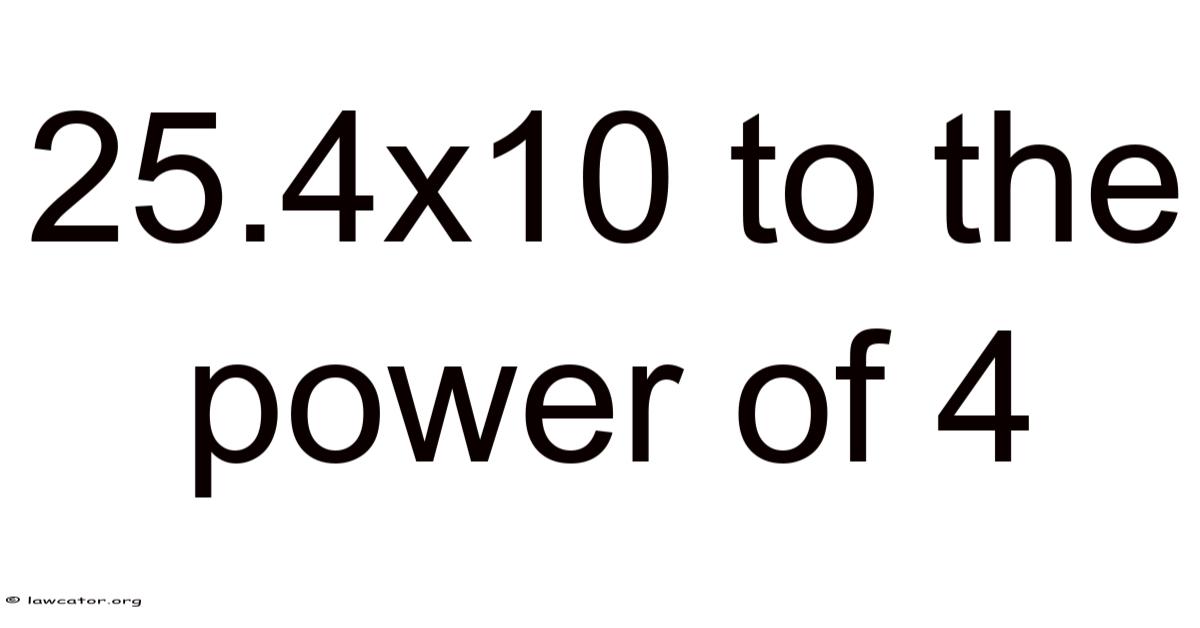
The expression 25.In this article we will unpack the meaning of each component, convert the notation into its standard form, explore where such numbers appear in everyday life, and answer the most common questions that arise when dealing with powers of ten. Which means by the end of the reading you will not only know that 25. 4 × 10⁴ may look intimidating at first glance, but it is simply a compact way of writing a large number using scientific notation. 4 × 10⁴ equals 254 000, but also why this format is useful, how to handle similar calculations, and how to avoid typical pitfalls.
Worth pausing on this one.
Understanding Scientific Notation
What is scientific notation?
Scientific notation is a method of expressing numbers that are too large or too small to be conveniently written in decimal form. It writes a number as a product of two parts:
- A coefficient – a decimal number between 1 (inclusive) and 10 (exclusive).
- A power of ten – an exponent that indicates how many places the decimal point should be moved.
As an example, the number 5,600 can be written as 5.Worth adding: 6 × 10³ because the decimal point moves three places to the left to turn 5600 into 5. 6 And that's really what it comes down to..
Why use scientific notation?
- Compactness – Large numbers like 25.4 × 10⁴ become easier to read and write.
- Precision – It clarifies the number of significant figures; in 25.4 × 10⁴ the coefficient 25.4 already contains three significant digits.
- Ease of calculation – Multiplying or dividing numbers becomes a matter of adding or subtracting exponents, which simplifies many scientific and engineering computations.
Converting 25.4 × 10⁴ to Standard Form
Step‑by‑step conversion
- Identify the exponent – The exponent is 4, meaning we need to move the decimal point four places to the right.
- Shift the decimal – Starting with 25.4, moving the decimal one place gives 254; two places gives 2 540; three places gives 25 400; four places gives 254 000.
- Write the result – The standard (decimal) form of 25.4 × 10⁴ is 254 000.
Key point: When the exponent is positive, the decimal point moves to the right; when it is negative, it moves to the left.
Quick verification
You can verify the conversion by breaking the multiplication:
[ 25.Practically speaking, 4 \times 10^4 = 25. Worth adding: 4 \times 10{,}000 = 25. 4 \times (10 \times 1{,}000) = (25.4 \times 10) \times 1{,}000 = 254 \times 1{,}000 = 254{,}000 Small thing, real impact..
Both approaches lead to the same answer, confirming the conversion.
Real‑World Applications
1. Population statistics
When a city’s population reaches 254 000 residents, demographers may write it as 25.4 × 10⁴ in reports to keep tables tidy and to underline the magnitude without cluttering the page.
2. Engineering and construction
In civil engineering, quantities such as the total length of piping or the volume of concrete are often expressed in scientific notation. Take this case: a project that requires 254 000 L of concrete can be recorded as 25.4 × 10⁴ L, making it easier to compare with other quantities.
The official docs gloss over this. That's a mistake.
3. Astronomy and space science
Distances in the universe are huge, but when dealing with smaller scales—like the distance a spacecraft travels in a short period—the notation helps keep numbers manageable. While 254 000 km is not cosmic, it illustrates how the same format applies across disciplines.
4. Finance
Large monetary values, such as a company’s annual revenue of $254 000 000, can be expressed as 25.4 × 10⁶ (or 25.4 × 10⁷ depending on the scale). The principle is identical; only the exponent changes Worth keeping that in mind..
Common Misconceptions
| Misconception | Reality |
|---|---|
| The exponent tells you how many digits the number has. | The exponent indicates how many places the decimal point moves, not the total digit count. |
| *25.Worth adding: 4 × 10⁴ is the same as 25. Also, 4 × 4. * | The “× 10⁴” means “times ten thousand,” not “times four.” |
| You must keep the coefficient between 1 and 10. | While standard scientific notation requires the coefficient to be between 1 and 10, the given expression already follows that rule (25.4 is >10). If you need to convert it to proper scientific notation, you would write 2.54 × 10⁵. |
FAQ
Q1: Can I write 25.4 × 10⁴ as 2.54 × 10⁵?
A: Yes. Moving the decimal one place to the left increases the exponent by one, so 25.4 × 10⁴ equals 2.54 × 10⁵. Both represent the same value, 254 000 But it adds up..
Q2: How many significant figures does 25.4 × 10⁴ have?
A: The coefficient 25.4 contains three significant figures. The power of ten does not add or remove any significant figures, so the entire expression has three.
Q3: Is there a shortcut for converting any number in the form a × 10ⁿ to standard form?
A: Absolutely. Count the exponent n; if it is positive, move the decimal point n places to the right. If n is negative, move it to the left. To give you an idea, 7.2 × 10⁻³ becomes 0.0072.
Q4: Does the notation affect how I perform addition or subtraction?
A: No. You must first convert each
Q4: No. You must first convert each term to a common power of ten (for example, rewrite 25.4 × 10⁴ as 2.54 × 10⁵) before carrying out addition or subtraction; only then can the numeric values be combined directly Not complicated — just consistent..
5. Everyday applications
The same compact format shows up in daily life, even when the numbers are far smaller than the astronomical distances discussed earlier.
- Population statistics – A city with 254 000 inhabitants may be listed as 2.54 × 10⁵ in a regional report, allowing the table to remain uncluttered while still conveying the scale.
- Energy consumption – A household that uses 254 000 kWh per year can be expressed as 2.54 × 10⁵ kWh, a figure that fits neatly into energy‑budget spreadsheets.
- Sports analytics – A runner who covers 254 000 meters over a season (approximately 158 miles) might be recorded as 2.54 × 10⁵ m, making it easier to compare performances across seasons.
In each case the notation does not change the underlying quantity; it merely provides a clearer visual cue for readers who are scanning tables, charts, or reports Worth knowing..
Conclusion
Scientific notation, as illustrated by the example 25.Consider this: whether engineers are estimating material volumes, astronomers are tracking spacecraft trajectories, financiers are reporting multi‑million‑dollar revenues, or everyday analysts are presenting population counts, the format offers consistency, precision, and readability. On top of that, 4 × 10⁴, is a versatile tool that transcends disciplinary boundaries. By mastering the simple rule of moving the decimal point in tandem with the exponent, anyone can switch smoothly between compact notation and full‑scale values, ensuring that complex numbers remain accessible and comparable across any context Worth keeping that in mind..
Scientific notation remains a cornerstone of mathematical communication, enabling efficient representation of complex quantities. Day to day, its utility persists across disciplines, ensuring clarity and consistency. Plus, such precision underpins countless advancements, bridging theory and practice effectively. Thus, mastering its principles remains essential for effective engagement with data-driven fields.
6. Future relevance in technology and data science
In the era of big data, scientific notation has become indispensable for managing vast datasets. Machine learning algorithms, for instance, often process values spanning dozens of orders of magnitude—from minuscule gradients in neural networks (e.g.On the flip side, , 1. In practice, 2 × 10⁻⁶) to massive training datasets (3. 5 × 10⁹ records). So similarly, climate models rely on scientific notation to represent atmospheric CO₂ levels (currently 4. Consider this: 2 × 10² ppm) or oceanic heat content changes over millennia. Without this shorthand, computational tools would struggle to maintain precision, and human analysts would face overwhelming complexity when interpreting results Simple, but easy to overlook..
In engineering, tolerances are frequently specified using scientific notation. Here's one way to look at it: a semiconductor manufacturer might define a chip’s operating voltage as 1.That's why 2 × 10⁻³ V, ensuring clarity in specifications that govern billions of devices. Meanwhile, financial systems use it to track national debts (**2 Took long enough..
Scientific notation remains a vital bridge between abstraction and application, underpinning progress across disciplines and ensuring clarity in an increasingly data-driven world. Its adaptability and precision remain indispensable, offering a universal language for analysis and communication.
Conclusion
Thus, mastering its principles ensures efficacy in navigating complexities, reinforcing its role as a cornerstone of modern expertise.
The next wave ofinnovation will embed scientific notation even more deeply into the fabric of emerging technologies. As quantum computers scale up, their intermediate results often span extreme ranges, making scientific notation the default display for both hardware diagnostics and user‑facing dashboards. In blockchain and cryptocurrency, where transaction values can range from fractions of a cent to billions of dollars, the notation provides a clear, unambiguous way to present balances without sacrificing readability.
Artificial intelligence platforms are already normalizing scientific notation in their internal representations to avoid overflow errors and to streamline feature engineering pipelines. Automated data‑visualization libraries now default to this format when axis values exceed a predefined threshold, sparing users the manual step of re‑formatting large numbers. Also worth noting, as edge computing devices become more powerful, on‑device analytics will increasingly rely on scientific notation to compress and transmit results in real time, conserving bandwidth while preserving numerical fidelity.
Education will also evolve to reflect this trend. Consider this: adaptive learning platforms will incorporate interactive modules that let students manipulate exponents directly, turning abstract exponent rules into tangible, visual experiences. Gamified simulations will challenge learners to convert between standard and scientific forms under time constraints, reinforcing fluency that will later prove crucial in scientific research, financial analysis, and software development Less friction, more output..
Short version: it depends. Long version — keep reading.
Across all these domains, the underlying principle remains unchanged: a compact, universally understood representation that eliminates ambiguity and facilitates rapid comprehension. As data volumes and computational demands continue to surge, the ability to work fluently with scientific notation will remain a foundational skill, ensuring that professionals can translate raw numbers into actionable insight with confidence and speed Small thing, real impact..
Conclusion
By internalizing the mechanics of scientific notation, individuals equip themselves with a universal language that bridges abstraction and concrete application. Its precision, brevity, and adaptability make it an essential instrument for anyone navigating the complexities of modern science, engineering, finance, or data science. Mastery of this format not only enhances personal competence but also contributes to the collective clarity needed for innovation and informed decision‑making in an increasingly quantitative world And it works..
