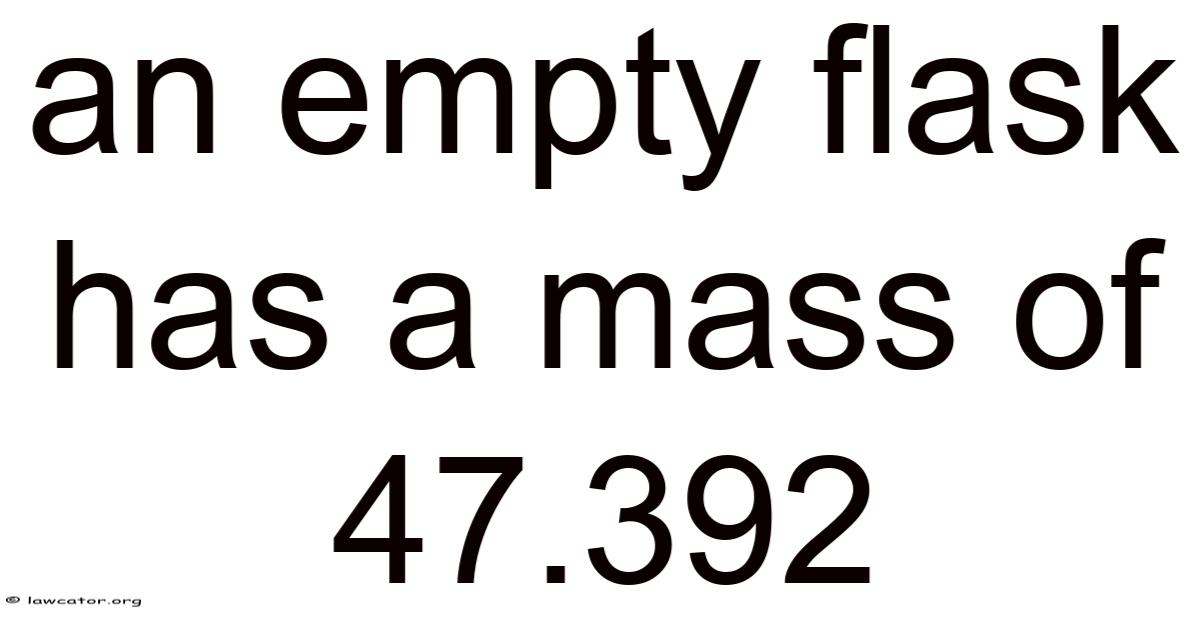
Understanding the mass of an empty flask, specifically an empty flask with a mass of 47.This seemingly simple question opens the door to deeper discussions about density, composition, and the properties of materials. 392 grams, is a fascinating topic that intersects physics, chemistry, and everyday life. Let’s dive into the details and explore what this mass signifies Not complicated — just consistent..
When we consider the mass of an empty flask, it’s essential to recognize that this number is not just a number—it’s a reflection of the flask’s composition and structure. An empty flask typically consists of glass, metal, or other materials that contribute to its overall mass. Think about it: in this case, the mass of 47. 392 grams is a crucial piece of information that helps us understand the density of the flask Nothing fancy..
To begin with, let’s break down what an empty flask is made of. The mass of 47.392 grams indicates the total weight of the flask when it is completely empty. This mass can be attributed to several factors, including the glass container, the metal or plastic components, and any additional materials used in its construction. Understanding these components is vital, as they influence the flask’s density and its ability to hold liquids.
The density of a material is defined as its mass per unit volume. In the case of an empty flask, density plays a significant role in determining how the flask interacts with liquids. In practice, for instance, a higher density means that the flask will be heavier for a given volume, making it more effective at holding liquids. The density of glass, for example, is approximately 2.Practically speaking, 5 grams per cubic centimeter. By calculating the volume of the flask and using this density, we can estimate how much liquid it can hold.
Not the most exciting part, but easily the most useful.
Now, let’s get into the calculation of the flask’s volume. Think about it: to find the volume, we need to know the density of the material it’s made from. So the mass of the empty flask is 47. 392 grams. If we assume the flask is primarily made of glass, which has a density of about 2.
[ \text{Volume} = \frac{\text{Mass}}{\text{Density}} ]
Plugging in the numbers:
[ \text{Volume} = \frac{47.Here's the thing — 392 \text{ grams}}{2. 2 \text{ grams/cm}^3} \approx 21 Small thing, real impact..
This calculation gives us the volume of the empty flask. With this volume, we can explore the flask’s capacity and its practical applications.
Understanding the volume is crucial for various uses, such as storing liquids, conducting experiments, or even in everyday tasks like making tea. The volume of 21.52 cubic centimeters indicates that the flask can hold a significant amount of liquid, making it suitable for a variety of purposes Surprisingly effective..
On top of that, the mass of 47.Practically speaking, this mass suggests that the flask is designed to withstand handling and use without breaking easily. 392 grams is not just a number; it reflects the flask’s robustness and durability. The material composition and the mass together tell a story about the flask’s purpose and the quality of its construction.
In addition to its physical properties, the mass of an empty flask also has implications in scientific research and education. When scientists measure the mass of materials, they often rely on precise calculations to understand their properties better. In this context, the mass of 47.392 grams serves as a benchmark for comparing different materials or conducting experiments.
Adding to this, the concept of mass is fundamental in various fields such as chemistry, physics, and engineering. It helps in understanding how objects behave under different conditions, how they interact with other substances, and how they can be manipulated in various processes. The mass of an empty flask is a microcosm of these broader principles Easy to understand, harder to ignore. Simple as that..
As we explore the significance of the mass of an empty flask, it’s also worth considering the environmental impact. The production and disposal of materials used in flasks can have significant consequences. Understanding the mass helps in assessing the sustainability of these materials and encourages a more mindful approach to using and recycling them Small thing, real impact..
Pulling it all together, the mass of 47.On the flip side, 392 grams for an empty flask is more than just a number—it is a gateway to understanding the flask’s composition, functionality, and importance in our daily lives. By examining this mass, we gain insights into the science behind everyday objects and the values they represent. Whether you’re a student, a scientist, or simply someone curious about the world around you, this information highlights the complex connections between numbers, materials, and their real-world applications. Embracing such knowledge not only enhances our understanding but also inspires us to appreciate the details that make our experiences richer and more meaningful It's one of those things that adds up..
