Introduction
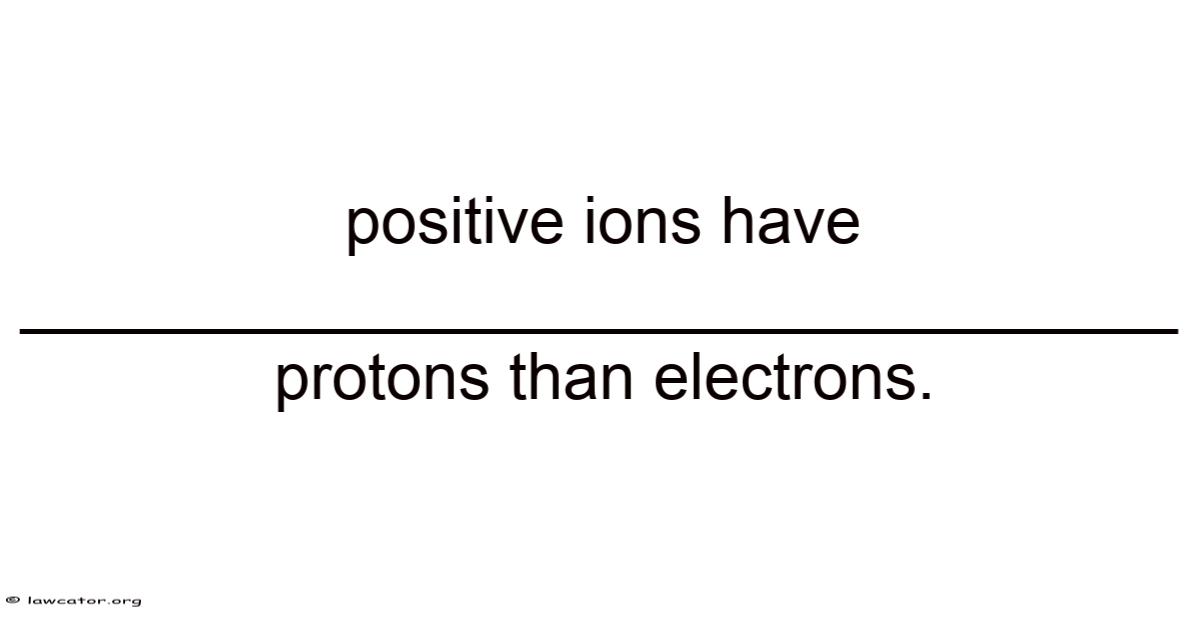
Positive ions have more protons than electrons, a defining characteristic that distinguishes them from neutral atoms and negative ions. Still, this article explores why the proton‑electron disparity occurs, how positive ions (also called cations) are created, the scientific principles behind their stability, and answers common questions that arise when studying these charged particles. Understanding this imbalance is fundamental to chemistry, physics, and countless everyday technologies, from batteries to biological signaling. By the end, readers will grasp the core concepts and feel confident applying them in academic or practical contexts The details matter here..
How Positive Ions Form
Electron Loss Mechanisms
- Ionization by Energy Transfer – When a neutral atom absorbs energy (through heat, light, or electrical discharge), an electron can be ejected from its outer shell.
- Chemical Reaction – Metals such as sodium readily give up an electron to non‑metals like chlorine, resulting in Na⁺ and Cl⁻ formation.
- Physical Removal – In a vacuum tube, high‑energy electrons collide with gas atoms, knocking electrons out and leaving behind positively charged ions.
Steps to Create a Cation
- Identify the Atom – Determine the element and its electron configuration.
- Provide Energy – Supply sufficient energy to overcome the electron binding energy.
- Eject an Electron – Remove one or more electrons, leaving the atom with a net positive charge.
- Stabilize the Ion – The resulting cation may attract nearby electrons or ions to achieve a more stable arrangement.
The key outcome of each step is that the number of protons (positively charged nuclei) remains unchanged, while the number of electrons decreases, producing a surplus of positive charge Easy to understand, harder to ignore..
Scientific Explanation of Proton‑Electron Imbalance
Atomic Structure Basics
- Protons reside in the nucleus and carry a +1 charge each.
- Electrons orbit the nucleus and carry a –1 charge each.
- In a neutral atom, the total positive and negative charges balance, resulting in no net charge.
Charge Conservation
When an electron is removed, the charge conservation principle dictates that the total charge of the system changes by +1 for each electron lost. Since the nucleus (proton count) does not change, the ion ends up with more protons than electrons, giving it a net positive charge That's the part that actually makes a difference. But it adds up..
Stability and Octet Rule
Cations tend to achieve a stable electron configuration, often resembling the nearest noble gas. Take this: sodium (Na) has electron configuration [Ne] 3s¹; losing one electron yields Na⁺ with the stable [Ne] configuration. The octet rule (or duet rule for hydrogen and helium) explains why many atoms prefer to lose electrons rather than gain them, leading to the formation of positive ions.
Role of Electronegativity
Atoms with low electronegativity (e.g.Plus, , halogens) tend to gain electrons, forming negative ions (anions). g., alkali metals) easily lose electrons, while those with high electronegativity (e.The contrast in electronegativity drives the direction of electron transfer and thus determines whether a species becomes a cation or an anion.
Common Examples of Positive Ions
- Sodium ion (Na⁺) – Formed when sodium loses its single 3s electron; crucial in nerve impulse transmission.
- Calcium ion (Ca²⁺) – Result of losing two electrons; essential for bone mineralization and muscle contraction.
- Ammonium ion (NH₄⁺) – Created when ammonia (NH₃) accepts an extra proton, giving it a +1 charge; common in fertilizers.
- Transition metal cations (e.g., Fe³⁺, Cu²⁺) – Play critical roles in catalysis and colored compounds.
These examples illustrate that positive ions have more protons than electrons, a universal feature across the periodic table.
Frequently Asked Questions
Q1: Can a positive ion ever have fewer protons than electrons?
A1: No. The number of protons is fixed by the element’s atomic number. Only the electron count can change, so a positive ion must always have more protons than electrons.
Q2: How does the charge magnitude relate to the electron deficit?
A2: The charge magnitude equals the difference between proton count and electron count. Take this case: losing two electrons from a neutral atom results in a +2 charge, meaning there are two more protons than electrons And it works..
Q3: Are there situations where a cation can gain electrons without becoming neutral?
A3: Yes. A cation can accept electrons to form a less positively charged ion (e.g., Na⁺ + e⁻ → Na), but it will not become neutral unless the exact number of electrons equal the proton deficit.
Q4: Why do some atoms form stable positive ions while others do not?
A4: Stability depends on achieving a favorable electron configuration (often a noble gas configuration). Atoms with low ionization energy, like alkali metals, readily lose electrons and form stable cations Most people skip this — try not to. And it works..
Q5: Do positive ions behave differently in solutions compared to neutral atoms?
A5: Indeed. In aqueous solutions, cations are solvated by water molecules, which can affect their reactivity, mobility, and participation in redox reactions.
Conclusion
The statement “positive ions have more protons than electrons” captures a fundamental truth about the nature of cations. This proton‑electron imbalance arises from the loss of electrons through ionization or chemical reactions, leading to a net positive charge that drives the behavior of ions in gases, liquids, and solids. By understanding how positive ions form, the scientific principles that govern their stability, and real‑world examples of their occurrence, readers
