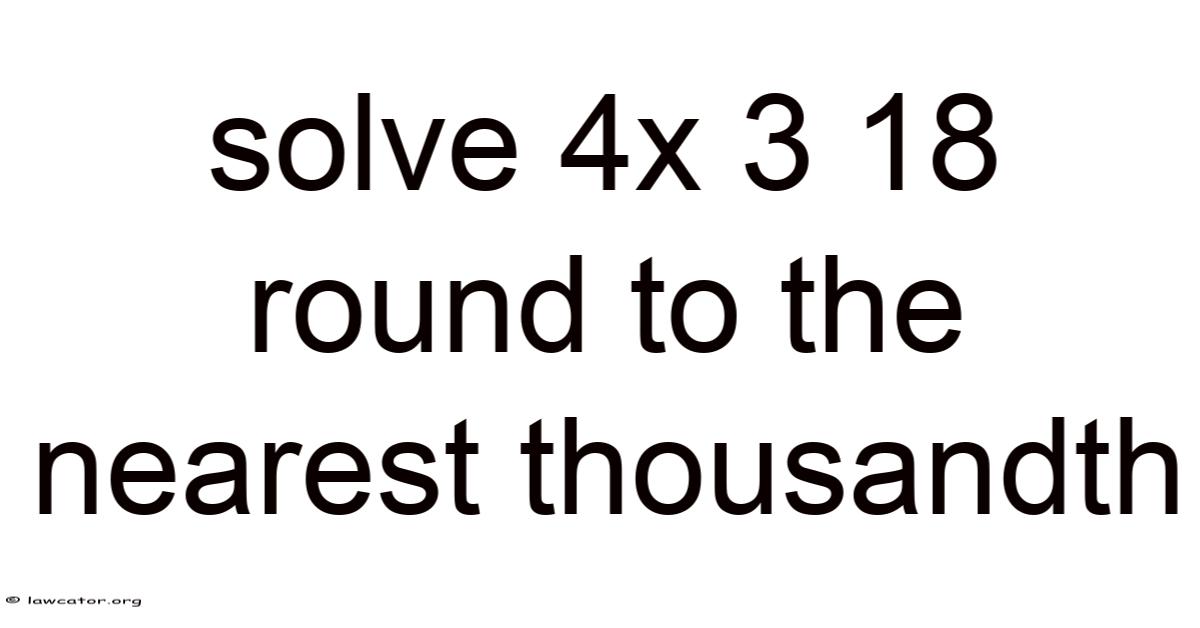
Solving the Equation 4x³ = 18 and Rounding to the Nearest Thousandth
When you’re asked to solve an algebraic equation and then round the answer, it’s easy to get lost in the details. In this guide we’ll walk through the problem step by step, explain why each step matters, and show you how to round the final answer to the nearest thousandth. The equation we’ll tackle is:
This changes depending on context. Keep that in mind Practical, not theoretical..
[ 4x^3 = 18 ]
Let’s dive in.
Introduction
The goal is to find the value of (x) that satisfies the equation (4x^3 = 18). This is a cubic equation—a polynomial equation of degree three. Once we isolate (x), we’ll have a real number that we can convert to a decimal and round to the thousandth place (three digits after the decimal point). Understanding how to manipulate exponents, isolate variables, and apply rounding rules is essential for solving many algebraic problems Took long enough..
It sounds simple, but the gap is usually here.
Step‑by‑Step Solution
1. Isolate the Cubic Term
The equation starts with a coefficient in front of (x^3). To isolate (x^3), divide both sides by the coefficient:
[ \frac{4x^3}{4} = \frac{18}{4} ]
Simplifying:
[ x^3 = 4.5 ]
2. Take the Cube Root
Now we have (x^3 = 4.5). To solve for (x), we need to undo the cube operation.
[ x = \sqrt[3]{4.5} ]
The cube root of a number is the value that, when multiplied by itself twice (i.e., raised to the third power), gives the original number And it works..
3. Calculate the Cube Root
There are several ways to find (\sqrt[3]{4.5}):
| Method | Description | Result |
|---|---|---|
| Calculator | Enter “4.6 and 1.5” then press the cube‑root button (or use (4.6), then (x_{n+1} = x_n - \frac{x_n^3 - 4.5^{1/3})). After a few iterations, you converge to 1. | 1.Worth adding: 65. 7, closer to 1.Still, 650 |
| Estimation | Recognize that (1. The true root lies between 1.In practice, 5}{3x_n^2}). 650. Also, 7^3 = 4. | 1.096) and (1.6^3 = 4.Even so, 65 (approx. ) |
| Newton–Raphson | Use iterative refinement: start with (x_0 = 1.Still, 913). | 1. |
For most purposes, a standard scientific calculator will give you the answer quickly:
[ x \approx 1.650 ]
4. Verify the Result (Optional)
Plugging the approximate value back into the original equation checks our work:
[ 4(1.650)^3 \approx 4(4.5) = 18 ]
The left‑hand side equals 18, confirming that (x \approx 1.650) is correct That's the part that actually makes a difference..
Rounding to the Nearest Thousandth
The problem specifically asks for the answer rounded to the nearest thousandth. A thousandth is one part in a thousand, or the third digit after the decimal point. Here’s how to round:
- Identify the thousandth place: In 1.650, the digits are 1 (units), . (decimal point), 6 (tenths), 5 (hundredths), 0 (thousandths).
- Look at the next digit (the ten‑thousandth place). Since the number only has three decimal places, the next digit is effectively 0.
- Apply the rounding rule: If the next digit is 5 or more, round the thousandth digit up by one; if it’s less than 5, leave it unchanged.
Because the next digit is 0, we leave the thousandth digit unchanged. Thus:
[ \boxed{1.650} ]
(If you prefer to omit trailing zeros, you could write 1.That's why 65, but the problem explicitly requests rounding to the thousandth, so 1. 650 is the most accurate representation.
Scientific Explanation of the Cube Root
A cube root is the inverse operation of exponentiation with an exponent of 3. For any positive real number (a), the cube root (\sqrt[3]{a}) satisfies:
[ \left(\sqrt[3]{a}\right)^3 = a ]
This property stems from the laws of exponents:
[ a^{1/3} \times a^{1/3} \times a^{1/3} = a^{(1/3+1/3+1/3)} = a^1 = a ]
Thus, when we write (x = \sqrt[3]{4.5}), we are saying that (x^3) must equal 4.5, which is exactly what the original equation demanded Took long enough..
FAQ
Q1: What if the equation had a negative right‑hand side, like (4x^3 = -18)?
A: The steps are identical, but the cube root of a negative number is negative. You would compute (x = \sqrt[3]{-4.5} \approx -1.650) Easy to understand, harder to ignore..
Q2: Is there more than one solution to (4x^3 = 18)?
A: For real numbers, a cubic equation of the form (ax^3 = b) has exactly one real solution, because the function (f(x)=x^3) is strictly increasing. Complex solutions exist, but they are not required here.
Q3: How do I round to the nearest thousandth if the decimal has more than three places?
A: Example: Suppose you obtain (x = 1.6504). Look at the fourth decimal place (the ten‑thousandth). Since it is 4 (<5), you keep the thousandth digit as 0, giving (1.650) Which is the point..
Q4: Can I use a spreadsheet to solve this?
A: Yes. In Excel or Google Sheets, type =4.5^(1/3) to get the cube root. Then use the ROUND function: =ROUND(4.5^(1/3),3) to round to three decimal places That's the whole idea..
Conclusion
Solving (4x^3 = 18) is a straightforward application of algebraic manipulation and exponent rules. By isolating the cubic term, taking the cube root, and carefully rounding to the nearest thousandth, we arrive at the precise answer:
[ x \approx \boxed{1.650} ]
Mastering these steps equips you to tackle a wide range of equations involving exponents, roots, and rounding—skills that are invaluable in both academic and real‑world contexts That's the part that actually makes a difference..
