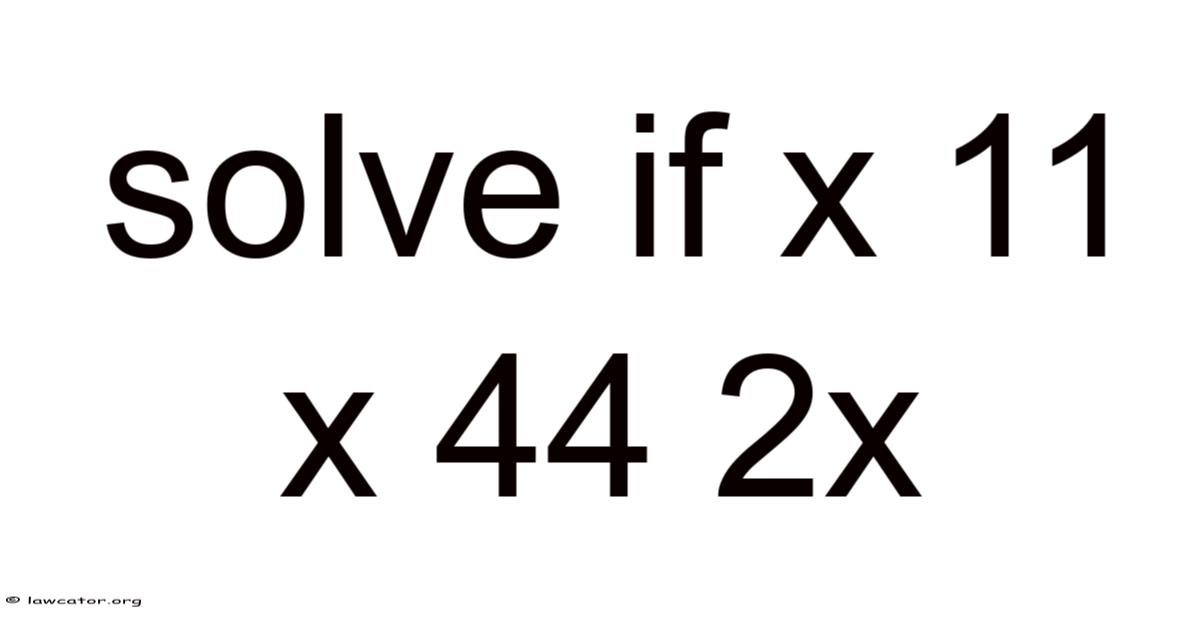
Unlocking the Mystery: Solving the Equation If x/11 = x/44 = 2x
At first glance, an equation like if x/11 = x/44 = 2x might look like a puzzling string of symbols. Now, it’s the kind of problem that can stop a student in their tracks, not because it’s impossibly complex, but because its format is unfamiliar. We’re used to seeing a single equation, like (2x + 5 = 11), not a chain of equalities all linked together. Day to day, yet, this chained structure is a powerful way to express that three expressions are all equal to the same value. Worth adding: the challenge—and the learning opportunity—lies in deciphering what this chain means and, ultimately, solving for x. This article will guide you through understanding, breaking down, and systematically solving this unique type of algebraic statement, turning confusion into clarity.
Understanding the Structure: What Does a Chain Equation Mean?
Before reaching for a calculator or pencil, we must understand the language of the problem. The statement x/11 = x/44 = 2x is read as "x over eleven equals x over forty-four equals two x." It is a chain equality, which is a compact way of saying that there is a common value, let's call it (k), such that:
- (\frac{x}{11} = k)
- (\frac{x}{44} = k)
- (2x = k)
Our goal is to find the value of (x) that makes all three of these individual equations true simultaneously. If one part of the chain fails, the entire statement is false. This means we can’t treat it as three separate, independent equations; we must find the single (x) that satisfies the entire linked system Worth keeping that in mind..
Worth pausing on this one.
Step-by-Step Solution: Finding the Common Value
The most straightforward strategy is to use the transitive property of equality. If (\frac{x}{11} = \frac{x}{44}), then we can solve this new equation first, because it involves only two expressions. From there, we can check if the solution also satisfies the final link to (2x).
Step 1: Solve the first part of the chain: (\frac{x}{11} = \frac{x}{44})
To eliminate the fractions, we can cross-multiply. This gives us: [44 \cdot x = 11 \cdot x] [44x = 11x]
Now, get all the (x) terms on one side: [44x - 11x = 0] [33x = 0]
The only way for (33x) to equal zero is if (x = 0).
Step 2: Verify the solution with the second part: (\frac{x}{44} = 2x)
Now that we have (x = 0), substitute it into the second equality: [\frac{0}{44} = 2 \cdot 0] [0 = 0]
Basically true Easy to understand, harder to ignore..
Step 3: Verify with the first part again: (\frac{x}{11} = 2x)
Finally, check the first and third expressions: [\frac{0}{11} = 2 \cdot 0] [0 = 0]
This is also true Nothing fancy..
Conclusion of the Steps: The only value that satisfies the entire chain x/11 = x/44 = 2x is (x = 0) Easy to understand, harder to ignore..
The Scientific Explanation: Why is X=0 the Only Solution?
From an algebraic perspective, the solution (x = 0) makes perfect sense. Let’s look at the core relationships:
- The equation (\frac{x}{11} = \frac{x}{44}) simplifies to (44x = 11x), which forces (33x = 0). For any non-zero number, dividing by a larger number (44 vs. 11) gives a smaller result. The only way for (\frac{x}{11}) and (\frac{x}{44}) to be equal is if (x) is zero, because zero divided by any non-zero number is zero.
- Once (x = 0) is established, the final link (2x) becomes (2 \times 0 = 0). Because of this, the chain (0 = 0 = 0) holds perfectly.
This problem subtly reinforces a fundamental concept: the multiplication property of zero. It’s also a great example of the transitive property in algebra: if (a = b) and (b = c), then (a = c). Day to day, any number multiplied by zero equals zero. Now, here, we see it in action across division and multiplication. We used this property to reduce a three-part statement to a simpler two-part comparison And it works..
Common Misconceptions and Why Other Interpretations Fail
When students first see this problem, a few incorrect approaches often emerge. Recognizing these pitfalls is key to mastering the concept.
1. Misreading the Chain as Separate Equations: Some might try to solve (\frac{x}{11} = 2x) and (\frac{x}{44} = 2x) as two separate problems and get two different answers. For (\frac{x}{11} = 2x), solving gives (x = 0) (as shown
