The detailed dance of atoms underpins the very fabric of the universe, yet understanding the precise composition of elements like copper becomes a journey into the heart of chemistry. Copper, a silvery metal with a metallic sheen and a rich history in human civilization, exists primarily in two stable isotopic forms: Cu-63 and Cu-64. This article digs into the atomic mass of copper-63, exploring its relevance beyond mere numbers, its contributions to technological advancements, and its place within the periodic table’s broader tapestry. These isotopes, though seemingly similar in mass, carry distinct implications for chemistry, biology, and industry. While Cu-64 is more abundant in nature, Cu-63 holds particular significance due to its unique properties and the nuanced role it plays in various scientific contexts. By examining the interplay between atomic structure, mass, and function, we uncover why even small differences in isotopic composition can lead to profound consequences, making copper-63 a subject of fascination and practical importance alike.
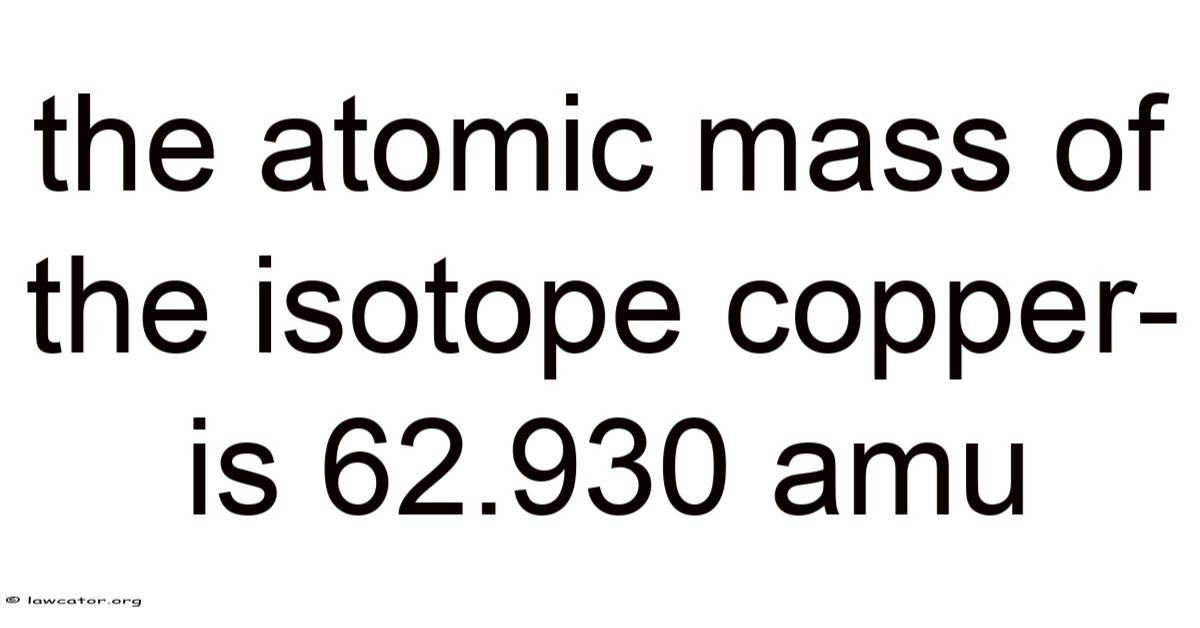
Copper’s isotopic diversity stems from its position in the periodic table, where its atomic number of 29 places it between zinc (Zn) and gallium (Ga). 930 atomic mass units (amu), represents a balance between mass and stability, allowing it to exist in equilibrium with Cu-64, which slightly heavier at 63.The stability of its isotopes is influenced by nuclear binding energies and the resulting atomic weights. 546 amu. Take this case: in electronic devices, the slight difference in atomic mass can influence semiconductor behavior, while in industrial settings, it may dictate material selection for corrosion resistance or catalytic efficiency. Cu-63, with approximately 62.This subtle variance affects properties such as electrical conductivity, thermal resistance, and reactivity, making copper-63 a preferred choice in applications where precision is very important. The interplay between mass and atomic structure thus becomes a critical factor in determining performance, underscoring why isotopic specificity matters beyond mere numerical value That alone is useful..
Beyond its practical applications, copper-63’s atomic mass serves as a bridge between theoretical chemistry and real-world outcomes. On the flip side, in agriculture, copper-63’s presence in soil minerals influences nutrient availability, affecting plant growth and ecosystem balance. On top of that, its presence in natural formations like copper deposits ties into geological processes, linking atomic-level details to macroscopic phenomena. In practice, its role in the human body, for example, is profound; copper is essential for oxygen transport via hemocyanin in mollusks and neurons, and it acts as a cofactor in enzymes involved in neurotransmission. That's why the precise atomic composition ensures these biological functions operate naturally, highlighting how even minute isotopic shifts can impact health and function. Such connections illustrate how microscopic atomic traits manifest on a larger scale, reinforcing the importance of understanding isotopic nuances in holistic scientific inquiry It's one of those things that adds up..
The study of copper-63 also intersects with historical and cultural contexts, as ancient civilizations harnessed its properties for metallurgy, currency, and art. Archaeological findings reveal copper artifacts dating back millennia, often linked to trade networks that shaped global economies. Modern advancements, such as nuclear physics and material science, have further expanded the utility of copper-63, enabling innovations in energy storage, medical imaging, and environmental monitoring. Here's a good example: its use in perovskite solar cells enhances efficiency in converting sunlight to electricity, while its role in battery technology supports the growing demand for sustainable energy solutions. These applications underscore how atomic-level precision translates into tangible benefits, bridging the gap between fundamental science and everyday life Practical, not theoretical..
Worth adding, the atomic mass of copper-63 invites exploration into the broader principles governing isotopic stability and mass effects. That said, understanding how slight variations in mass influence properties requires mastery of quantum mechanics and statistical chemistry. The periodic table’s periodic trends reveal patterns where isotopic composition acts as a key variable, often determining an element’s reactivity, melting point, or magnetic properties. In real terms, this knowledge empowers scientists to predict behaviors and design materials with tailored characteristics, whether in constructing alloys for aerospace applications or developing catalysts for industrial processes. Such insights are not merely academic; they directly impact cost-efficiency, safety, and performance, making the study of copper-63 a cornerstone of applied science The details matter here..
Critically, the atomic mass of copper-63 also serves as a focal point for discussions on isotopic enrichment and natural abundance. Researchers often seek to enrich specific isotopes for specific applications, such as improving the efficiency of nuclear reactors or optimizing pharmaceutical formulations. While Cu-63 constitutes about 94% of natural copper, its isotopic distribution is subject to natural variations influenced by environmental factors and geological processes. This practice highlights the dynamic relationship between natural occurrences and human intervention, emphasizing the need for adaptive strategies in managing resources. Additionally, the pursuit of isotopic purity drives technological progress, pushing the boundaries of analytical techniques and material engineering.
Pulling it all together, the atomic mass of copper-63 encapsulates a microcosm of scientific principles that shape our world. In real terms, from its role in sustaining life to its influence on technological innovation, copper-63 exemplifies how atomic-level details permeate broader systems. As research continues to uncover new facets of its properties, the importance of this isotope remains unchanged, serving as a testament to the enduring relevance of chemistry in addressing contemporary challenges That's the part that actually makes a difference..
serves as an indispensable atomic building block underpinning modern civilization. Worth adding: its precise mass isn't merely a number; it's a fundamental parameter dictating electron behavior, lattice stability, and ultimately, the macroscopic properties that make copper indispensable. Whether enabling the efficient transmission of power through its exceptional conductivity, forming the cathode in lithium-ion batteries that power our devices, or acting as a critical cofactor in enzymes essential for life, copper-63 exemplifies the profound connection between atomic structure and global functionality.
The study of copper-63 extends beyond its immediate utility, offering a vital laboratory for probing nuclear physics and geochemical processes. Variations in its isotopic ratio across natural samples provide clues to planetary formation, weathering cycles, and even biological fractionation, serving as a natural tracer for Earth's dynamic systems. What's more, the pursuit of isotopically pure copper-63 for specialized applications, such as in neutrino detection experiments or advanced semiconductors, pushes the boundaries of analytical chemistry and material synthesis, demanding ever-greater precision and ingenuity.
In the long run, the atomic mass of copper-63 transcends its specific isotope, embodying a core principle of science: that understanding the smallest constituents unlocks the potential to manipulate and put to use the material world at every scale. On top of that, its story is one of fundamental physics enabling transformative technology, of natural abundance meeting engineered precision, and of a single atomic property resonating through biology, energy, industry, and environmental science. As we confront challenges in sustainability, energy storage, and advanced materials, the meticulous study and application of copper-63 stand as a powerful reminder that the answers to our largest questions often lie hidden within the complex dance of atoms Most people skip this — try not to..
