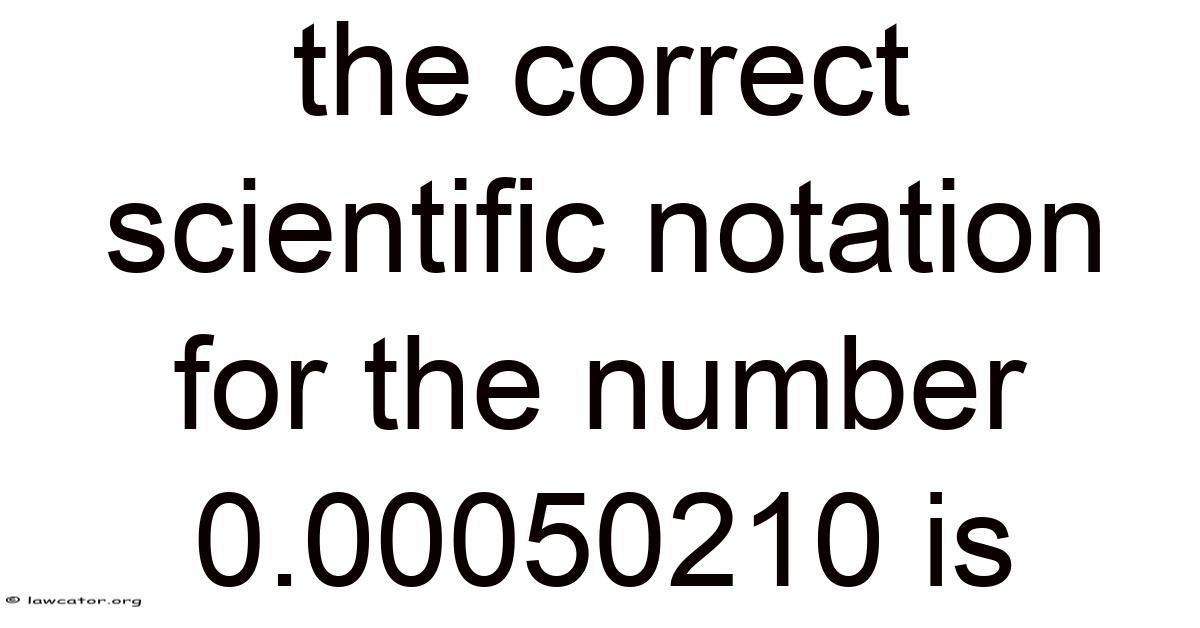
Understanding Scientific Notation and the Correct Form for 0.00050210
Scientific notation is a compact way of writing very large or very small numbers, allowing easier calculation, comparison, and communication across scientific disciplines. Which means this article explains the rules governing scientific notation, walks through the step‑by‑step conversion of 0. 00050210, expressing it in scientific notation not only follows a universal convention but also reduces the chance of transcription errors. When you encounter a value like 0.00050210, explores the underlying mathematics, and answers common questions that often arise when dealing with decimal numbers in scientific contexts.
Introduction: Why Scientific Notation Matters
In fields ranging from chemistry and physics to engineering and finance, numbers can span many orders of magnitude. In real terms, writing 0. 00050210 in plain decimal form forces the reader to count four leading zeros before reaching the first significant digit, a process that is both time‑consuming and error‑prone.
- Standardising the format: a single digit (1‑9) before the decimal point, followed by the remaining significant digits, multiplied by a power of ten.
- Facilitating calculations: multiplication and division become simple addition or subtraction of exponents.
- Improving readability: the exponent instantly conveys the scale of the number.
Because of these benefits, most textbooks, research papers, and data‑analysis software require numbers to be expressed in scientific notation whenever the absolute value is less than 10⁻³ or greater than 10³.
Step‑by‑Step Conversion of 0.00050210
1. Identify the first non‑zero digit
The decimal 0.00050210 begins with three zeros after the decimal point, followed by the digit 5. This digit is the first significant figure.
2. Move the decimal point to create a coefficient between 1 and 10
Shift the decimal point four places to the right so that the number becomes 5.0210.
- Original: 0 . 0 0 0 5 0 2 1 0
- After shifting 4 places: 5 . 0 2 1 0
The coefficient 5.0210 now satisfies the scientific‑notation rule of having one non‑zero digit to the left of the decimal point.
3. Determine the exponent
Because the decimal point was moved four places to the right, the exponent must be ‑4 to compensate for the shift and keep the value unchanged Most people skip this — try not to. And it works..
4. Assemble the final notation
Combine the coefficient with the power of ten:
[ \boxed{5.0210 \times 10^{-4}} ]
This is the correct scientific notation for 0.00050210.
Key Rules to Remember
| Rule | Explanation | Example |
|---|---|---|
| One non‑zero digit before the decimal | Guarantees a unique representation. 5 × 10³ = 2500; 4. | 5.0210 × 10⁻⁴ (the trailing zero shows precision to the ten‑thousandths place). |
| Exponent indicates decimal movement | Positive exponent → move left; negative exponent → move right. 02, 9.Here's the thing — 14, 6. That's why 047 | |
| All significant figures are retained | Do not drop trailing zeros that are part of the measured precision. | |
| Zero coefficient is a special case | Zero is written as 0 × 10⁰ regardless of magnitude. |
Applying these rules ensures that your scientific notation is both mathematically accurate and compliant with international standards such as the International System of Units (SI).
Scientific Explanation: Why the Exponent Is Negative
When the original number is less than one, the decimal point must be moved rightward to obtain a coefficient between 1 and 10. 1, 10⁻² = 0.Still, each rightward shift reduces the magnitude of the number by a factor of ten. Still, to counterbalance this reduction, the exponent must be negative, indicating multiplication by a fraction (10⁻¹ = 0. 01, etc.) Turns out it matters..
For 0.00050210, moving the point four places right multiplies the number by 10⁴, turning it into 5.0210 Easy to understand, harder to ignore..
[ 5.0210 \times \frac{1}{10^{4}} = \frac{5.0210 \times 10^{-4} = 5.0210}{10^{4}} = 0.
The negative exponent is therefore a mathematical “undo” of the decimal shift.
Practical Applications
- Laboratory measurements – Concentrations in chemistry (e.g., molarity of a dilute solution) are often in the 10⁻⁴ to 10⁻⁶ range. Reporting 0.00050210 M as 5.0210 × 10⁻⁴ M aligns with journal guidelines.
- Astronomical data – While astronomers usually deal with large numbers, certain measurements (e.g., albedo values) can be tiny and benefit from scientific notation.
- Engineering tolerances – Precision machining may require dimensions expressed to the micrometer (10⁻⁶ m). A part length of 0.00050210 m is more clearly communicated as 5.0210 × 10⁻⁴ m.
In each case, the notation eliminates ambiguity and streamlines calculations.
Frequently Asked Questions (FAQ)
Q1: Can I drop the trailing zero and write 5.021 × 10⁻⁴?
A: You may drop it if the zero does not convey measurement precision. In scientific reporting, trailing zeros are significant because they indicate the certainty of the measurement. If the original value 0.00050210 was measured with five significant figures, keep the zero: 5.0210 × 10⁻⁴.
Q2: What if the number is exactly 0?
A: Zero is a special case. The standard form is 0 × 10⁰ (or simply 0). No exponent is needed because any power of ten multiplied by zero remains zero.
Q3: How does scientific notation differ from engineering notation?
A: Engineering notation uses exponents that are multiples of three (e.g., 10³, 10⁶) to align with SI prefixes (kilo, mega, etc.). For 0.00050210, engineering notation would be 502.10 µ (micro) or 0.50210 milli‑micro—but scientific notation remains 5.0210 × 10⁻⁴.
Q4: Is there a shortcut for converting numbers with many leading zeros?
A: Count the number of zeros after the decimal point before the first non‑zero digit; that count becomes the absolute value of the negative exponent. Then write the remaining digits as the coefficient. For 0.00050210, there are four leading zeros → exponent ‑4.
Q5: Does the sign of the exponent affect significant figures?
A: No. The exponent merely scales the coefficient; the number of significant figures is determined solely by the digits in the coefficient (including any trailing zeros that are known to be measured) Which is the point..
Common Mistakes to Avoid
- Using a coefficient larger than 10 – Writing 50.210 × 10⁻⁵ is incorrect because the coefficient must be < 10.
- Omitting significant trailing zeros – Dropping the final zero when the original measurement includes it reduces precision.
- Applying the wrong sign to the exponent – For numbers less than one, the exponent must be negative; a positive exponent would incorrectly increase the value.
- Miscounting decimal shifts – Double‑check the number of places the decimal moves; a simple off‑by‑one error changes the exponent and yields an entirely different magnitude.
Real‑World Example: Converting a Laboratory Result
Imagine a chemist measures the concentration of a trace contaminant as 0.00050210 mol/L. The lab’s reporting template requires scientific notation with three significant figures.
- Identify the coefficient: 5.0210 (five significant figures).
- Round to three significant figures: 5.02.
- Apply the exponent ‑4 (four places moved).
Result: 5.02 × 10⁻⁴ mol/L Easy to understand, harder to ignore..
Notice how the rounding step preserves the required precision while still adhering to the scientific‑notation format.
Conclusion
Expressing 0.But 0210 × 10⁻⁴ follows a clear set of rules: a single non‑zero digit before the decimal point, an exponent that reflects the number of decimal shifts, and retention of all significant figures. Mastering this conversion enhances clarity in scientific communication, reduces computational errors, and aligns your work with international standards. Even so, 00050210** in scientific notation as **5. Whether you are drafting a research paper, recording laboratory data, or performing engineering calculations, using the correct scientific notation ensures that your numbers are instantly understandable and mathematically sound Simple, but easy to overlook. Took long enough..
By internalising the step‑by‑step method outlined above, you’ll be equipped to handle any decimal—no matter how small or large—and present it in the universally recognised, efficient format that underpins modern science and technology.
