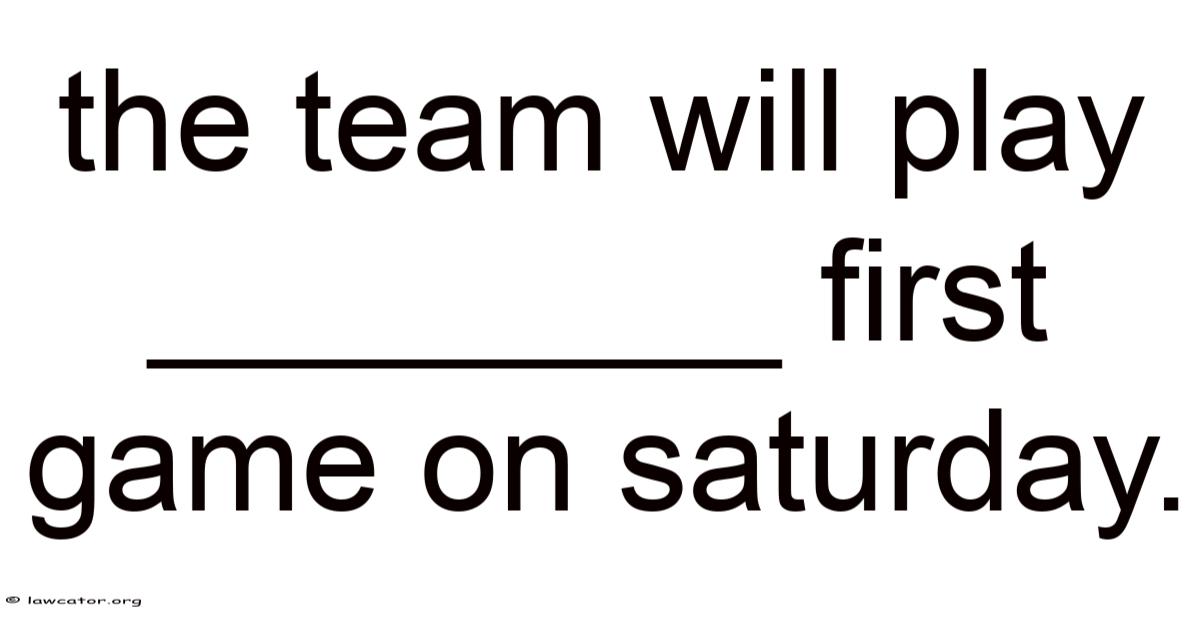
Understanding the correct word to fill in the blank for the sentence "the team will play ________ first game on saturday" is a classic exercise in subject-verb agreement and pronoun consistency. While it appears simple on the surface, this sentence structure touches on one of the most debated topics in English grammar: collective nouns. Whether you are a student preparing for an exam, a professional polishing a business email, or a writer crafting a narrative, mastering this distinction ensures your communication is precise and grammatically sound Took long enough..
The Short Answer: "Its" vs. "Their"
Before diving deep into the mechanics, let’s address the two most common correct answers.
- "Its" is the standard choice in American English and formal writing when the collective noun (team) acts as a single, unified unit.
- "Their" is widely accepted in British English and increasingly in modern global English when the emphasis is on the individual members of the group acting separately.
So, the completed sentence usually reads:
"The team will play its first game on Saturday." (Formal/US Standard) "The team will play their first game on Saturday." (UK Standard/Notional Agreement)
Why the Confusion Exists: The Nature of Collective Nouns
To truly understand why both options exist, we must define what a collective noun is. In practice, a collective noun refers to a group of individuals—people, animals, or things—treated as a single entity. Common examples include team, committee, family, audience, jury, staff, crowd, and class And it works..
The grammatical tension arises because a collective noun is singular in form (it looks like one thing) but plural in meaning (it implies multiple people). This duality forces a choice: do we treat the grammar as singular (matching the form) or plural (matching the meaning)?
Short version: it depends. Long version — keep reading.
The Singular Approach: Formal Agreement (Grammatical Concord)
In traditional grammar, specifically formal agreement, the verb and subsequent pronouns must match the grammatical number of the subject. Since "team" is a singular noun, it takes a singular verb (plays, is, has) and singular pronouns (it, its, itself) And that's really what it comes down to..
- Example: "The team is celebrating its victory."
- Reasoning: The team functions as one block. The focus is on the institution or the unit as a whole.
This is the preferred standard in American English, academic writing, legal documents, and most standardized tests (like the SAT, ACT, GMAT, and TOEFL). If you are taking a formal grammar test in a US context, "its" is the only correct answer.
The Plural Approach: Notional Agreement (Synesis)
Notional agreement (or synesis) argues that agreement should be based on the meaning (notion) of the word rather than its strict grammatical form. Since a "team" consists of multiple players who run, think, and act individually, many writers—particularly in the UK, Australia, Canada, and New Zealand—prefer plural verbs and pronouns.
- Example: "The team are arguing among themselves."
- Reasoning: The individuals within the team are doing the arguing. The "group" cannot argue with itself; only the people can.
In the context of our target sentence—"the team will play ________ first game on saturday"—the action of "playing a game" is something the players do physically on the field. Because of this, a British writer would likely write: "The team will play their first game on Saturday."
The "Decision Matrix": How to Choose the Right Word
Since both can be "correct" depending on the dialect and context, how do you decide which to use? Apply this three-step decision matrix.
1. Identify Your Audience and Style Guide
- US Academic / Corporate / Standardized Testing: Use "its". (AP Style, Chicago Manual of Style, MLA, APA generally prefer singular for collective nouns acting as a unit).
- UK / Commonwealth / Creative Writing / Journalism (UK): "Their" is perfectly standard and often preferred for natural flow.
- International Business / Global Web Content: "Its" is the safer "neutral" choice because it is universally accepted as grammatically correct in formal English, whereas "their" with a singular antecedent is still flagged as an error by some US-based grammar checkers.
2. Analyze the Verb in the Sentence
Look at the main verb. In our sentence, the verb phrase is "will play." This is a modal verb construction (will + bare infinitive). Crucially, modal verbs do not change form for singular or plural subjects.
- Singular: The team will play.
- Plural: The players will play.
Because the verb will play masks the number, the sentence gives you no grammatical clue. You must rely entirely on the pronoun choice (its vs their) to signal your intent Simple, but easy to overlook..
3. Determine the "Unity" of the Action (The Conceptual Test)
Ask yourself: Is the group acting as a single monolith, or as individuals?
- Scenario A (Unity): "The team has decided on its captain." (The decision is a single corporate act).
- Scenario B (Individual Action): "The team are putting on their uniforms." (Each player puts on their own uniform).
Applying this to "playing a game":
- In a sport like soccer or basketball, the team must coordinate as a unit to play the game. You could argue for "its" (the franchise plays the game).
- On the flip side, the physical act of running, kicking, and passing is done by individuals. You could argue for "their".
Verdict: For "playing a game," both work. Still, "its" emphasizes the institution/franchise (The Lakers play their game vs. The Lakers organization plays its game), while "their" emphasizes the players.
Common Pitfalls and How to Avoid Them
Even advanced speakers stumble here. Here are the top three errors to watch for And that's really what it comes down to..
Pitfall 1: The "Singular They" Confusion
Modern English increasingly uses singular "they/their" for a person of unknown or non-binary gender (e.g., "A student should bring their book"). Do not confuse this with collective nouns.
- Collective Noun: The team $\rightarrow$ Its/Their (Group dynamic).
- Singular Generic Person: A player $\rightarrow$ Their (Gender neutrality). They follow different logic. In our sentence, "team" is definitely a collective noun.
Pitfall 2: Inconsistent Agreement (The "Flip-Flop")
The cardinal sin of collective nouns is switching number mid-sentence or mid-paragraph.
- Incorrect: "The team is playing well. They are going to win its next game."
- Correct (Singular): "The team is playing well. It is going to win its next game."
- Correct (Plural): "The team are playing well. They are going to win their next game."
Consistency is king. Pick a lane (singular entity or plural members) and stay in it for the duration of the context.
Pitfall 3: Misidentifying the Antecedent
Sometimes a prepositional phrase follows the collective noun, confusing the writer Most people skip this — try not to..
- Example: "The team of players will play ________ first game."
- Error: Choosing "their" because "players" is plural and right next to the blank.
- Rule: The subject is
"the team," not "players." (Focus on the unit). " The phrase "of players" is merely a modifier. * Correct: "The team of players will play their first game.So, the pronoun must agree with the head noun. On the flip side, * Correct: "The team of players will play its first game. " (Focus on the individuals).
Regional Nuances: American vs. British English
To truly master this, you must recognize that the "correct" answer often depends on which side of the Atlantic you are on.
American English (AmE): American speakers have a strong preference for treating collective nouns as singular. To an American ear, "The team are playing" often sounds grammatically incorrect. In the U.S., the default is almost always "its."
British English (BrE): British speakers are far more flexible. In the UK, it is standard to treat collective nouns as plural, especially in sports. It is perfectly normal to hear "England are playing well" or "The team have taken their positions."
If you are writing for a global audience, the safest bet is to follow the style guide of your target region. If you are writing for a US-based publication, lean toward the singular; for a UK-based one, the plural is often more natural.
The "Cheat Code": How to Avoid the Dilemma Entirely
If you find yourself staring at a sentence and feeling paralyzed by the choice between "its" and "their," the most professional solution is to rephrase the sentence. By adding a clarifying word, you remove the ambiguity and the risk of error Not complicated — just consistent..
- Instead of: "The team is playing its/their game."
- Try: "The team members are playing their game." (Clearly plural).
- Try: "The organization is playing its game." (Clearly singular).
By explicitly stating "members," "players," or "staff," you force the pronoun into a plural agreement, making the sentence crystal clear and grammatically bulletproof Most people skip this — try not to..
Final Summary and Conclusion
Navigating collective nouns is less about a rigid "right or wrong" and more about intent and consistency. Whether you choose "its" or "their" depends on whether you view the group as a single, cohesive entity or as a collection of individual people.
To ensure your writing remains polished:
-
- Maintain consistency: Once you choose a number, stick with it throughout the entire passage. Think about it: Check the region: Are you following American (singular-leaning) or British (plural-leaning) conventions? 2. Identify the focus: Is it the institution (singular) or the people (plural)? Also, 3. When in doubt, rephrase: Add "members" or "players" to eliminate the guesswork.
By applying these rules, you move beyond basic grammar and begin using language to signal subtle nuances of meaning, allowing your reader to understand exactly whether you are discussing a unified force or a group of individuals working in concert Surprisingly effective..
