Understanding the Confusion Between "Entender" and "Entender" in Spanish: A Common Language Learning Mistake
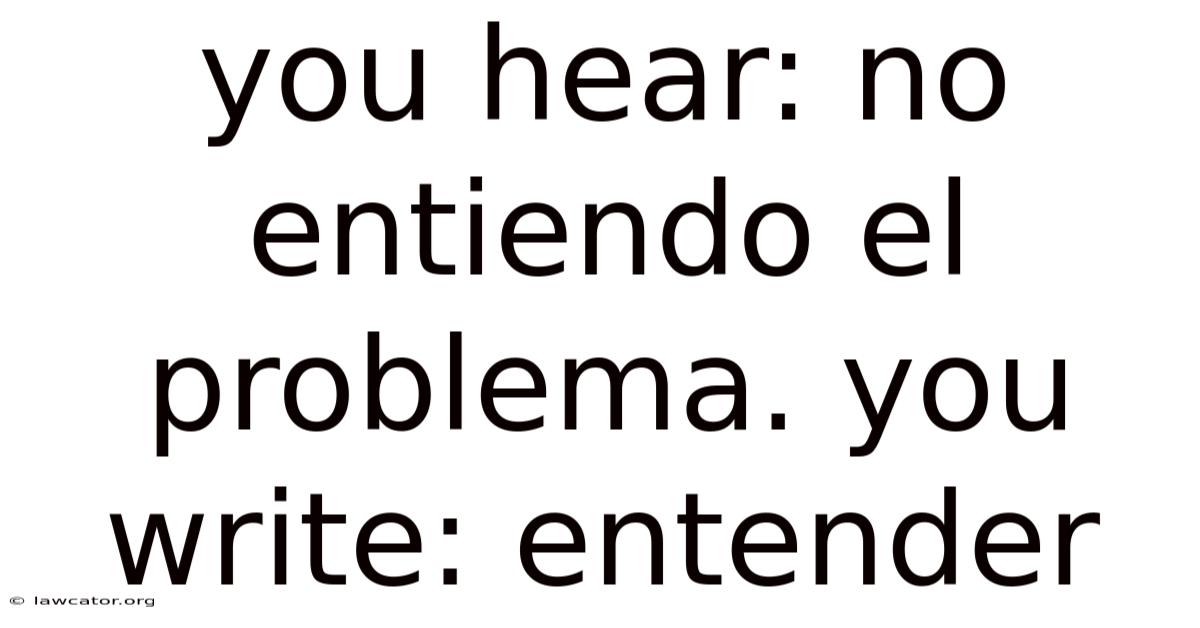
When learning a new language, even small grammatical errors can lead to significant misunderstandings. The phrase "you hear no entiendo el problema you write entender" highlights a common pitfall: mixing up the infinitive form entender with the conjugated form entiendo. But one such confusion that often arises among Spanish learners is the misuse of the verb entender. This article will explore the correct usage of entender in Spanish, clarify why this confusion occurs, and provide practical examples to help learners avoid similar mistakes.
What Does "Entender" Mean in Spanish?
At its core, entender is a versatile Spanish verb that translates to "to understand" in English. It is used to express comprehension of ideas, situations, or languages. In practice, the infinitive entender is the base form, while entiendo is the first-person singular present tense. " That said, the verb changes form depending on the subject and tense. In real terms, for example, "Entiendo español" means "I understand Spanish. This distinction is crucial for constructing grammatically correct sentences Not complicated — just consistent..
This changes depending on context. Keep that in mind.
The confusion between entender and entiendo often stems from the similarity in pronunciation and spelling. Both words are derived from the same root, but their usage differs based on context. To give you an idea, entender is used when referring to the general action of understanding, while entiendo is specific to the speaker’s current action Simple as that..
Common Mistakes: Why "Entender" Is Misused
One of the most frequent errors is using entender instead of entiendo in sentences where the subject is "I.Now, " Take this: a learner might incorrectly say, "No entiendo el problema" (which is correct) but then write "No entender el problema" (which is incorrect). The latter omits the conjugation, making the sentence grammatically flawed Small thing, real impact. Nothing fancy..
Another
Another frequent error arises in questions and negative statements. On top of that, learners might incorrectly form questions like, "¿Entiendes tú? " (correct) versus the awkward "¿Entender tú?" (incorrect). But similarly, negatives like "No entender" instead of "No entiendo" disrupt the sentence's grammatical flow. These mistakes often occur because learners focus on the English structure ("to understand" remains unchanged regardless of subject or tense) without fully internalizing Spanish's conjugation requirements Less friction, more output..
The consequences of this confusion extend beyond grammatical correctness. Also, misusing entender and entiendo can lead to ambiguity or misinterpretation. Take this: saying "Entender el problema" could imply a general, abstract concept ("Understanding the problem") rather than the speaker's specific lack of comprehension ("I don't understand the problem"). Such nuances are vital for clear, effective communication And that's really what it comes down to..
Practical Tips to Master the Difference
- Prioritize Conjugation: Remember that Spanish verbs change form. Always conjugate entender according to the subject (yo, tú, él/ella/usted, etc.) and tense. In present tense, "I" is entiendo, "you (informal)" is entiendes, "he/she/you formal" is entiende, and so on.
- Infinitive for Specific Uses: Reserve the infinitive entender for contexts where it's grammatically required: after modal verbs like poder (puedo entender - I can understand), as the subject of a sentence (Entender esto es difícil - Understanding this is difficult), or after certain prepositions (sin entender - without understanding).
- Context is Key: Pay attention to the subject of the sentence. If it's "I" (yo) and you're talking about understanding now, use entiendo. If the action is more general or refers to the verb itself, use the infinitive.
- Practice with Examples: Drill sentences aloud: "Yo entiendo" (I understand), "Tú entiendes" (You understand), "¿Entiendes?" (Do you understand?), "No entiendo" (I don't understand), "Necesito entender" (I need to understand). Hearing and repeating reinforces correct usage.
Conclusion
Mastering the distinction between the infinitive entender and its conjugated forms like entiendo is fundamental for achieving grammatical accuracy and clear communication in Spanish. While the similarity in spelling and sound can cause confusion, understanding that Spanish verbs are highly sensitive to subject and tense is the key. Now, by recognizing that entiendo is the specific form for "I understand" and reserving entender for its grammatically appropriate contexts, learners can avoid common errors and express their comprehension precisely. This attention to verb conjugation not only enhances grammatical correctness but also ensures that messages are conveyed clearly and effectively, paving the way for greater fluency and confidence in the Spanish language. Consistent practice and mindful attention to context will solidify this crucial distinction Took long enough..
Beyond the Basics: Subtle Shades of Meaning
The careful application of entiendo versus entender also reveals subtle differences in emphasis and nuance. Here's the thing — using entiendo frequently, particularly in rapid conversation, can sometimes convey a sense of immediate, active understanding – a “got it” moment. Conversely, employing entender often suggests a more considered, reflective process of comprehension, perhaps implying a deeper analysis or a longer-term grasp of a concept. Consider the phrase “Entiendo lo que dices” (I understand what you’re saying) versus “Entiendo” (I understand) – the former carries a slightly stronger implication of agreement and acknowledgement of the speaker’s viewpoint That alone is useful..
Beyond that, the choice can subtly alter the tone. Which means Entiendo can feel more empathetic, suggesting a willingness to grasp the other person’s perspective. Practically speaking, Entender, on the other hand, can sound more objective, focusing on the intellectual process of comprehension itself. These are not rigid rules, of course, but recognizing these potential variations allows for a richer and more expressive use of the verb.
It sounds simple, but the gap is usually here.
Expanding Your Vocabulary: Related Expressions
To further solidify your understanding, familiarize yourself with related expressions that frequently use entender. Phrases like “No puedo entender” (I can’t understand), “Es difícil entender” (It’s difficult to understand), and “Necesito entender esto” (I need to understand this) provide valuable context and demonstrate the versatility of the verb. Exploring idioms and common expressions that incorporate entender will not only expand your vocabulary but also deepen your appreciation for the nuances of the Spanish language.
Conclusion
When all is said and done, the mastery of entender and entiendo transcends mere grammatical correctness; it’s about cultivating a deeper sensitivity to the subtleties of Spanish communication. On top of that, by diligently applying the principles outlined – prioritizing conjugation, recognizing infinitive usage, and paying close attention to context – learners can move beyond simply avoiding errors and begin to wield this fundamental verb with precision and expressive power. This careful attention to detail, coupled with continued practice and exposure to authentic Spanish, will undoubtedly contribute significantly to achieving fluency and confidently navigating the complexities of the language.
Building on the foundation of correctconjugation and contextual awareness, learners often encounter a few recurring stumbling blocks that merit special attention. One frequent source of confusion arises when entender appears in subordinate clauses triggered by verbs of perception, emotion, or doubt. Even so, in such constructions, the infinitive may shift to the subjunctive, as in “Dudo que usted entienda la instrucción” (I doubt that you understand the instruction). Recognizing when the verb must adopt the subjunctive mood helps avoid the temptation to default to the indicative entiende simply because the main clause feels certain.
Another nuance involves the use of entender with reflexive pronouns to convey self‑comprehension or realization. In practice, phrases like “Me entiendo mejor ahora” (I understand myself better now) or “Se entiende que hay que actuar rápido” (It is understood that we must act quickly) illustrate how the reflexive form can shift the focus from an external object to an internal state or a general consensus. While these constructions are less common in everyday speech, they appear frequently in written registers, academic texts, and formal discourse, making them valuable to recognize when reading advanced material.
Regional variation also plays a subtle role. In some Latin American countries, speakers may favor the present progressive estoy entendiendo to stress an ongoing process of comprehension, whereas in Spain the simple present entiendo often suffices even when the action is in progress. Neither form is incorrect, but being attuned to these preferences can make one’s speech sound more natural to native interlocutors from a specific area Worth keeping that in mind. Worth knowing..
To reinforce these points, targeted practice can be highly effective. Consider the following micro‑exercise: take a short paragraph in English that contains a mix of factual statements, doubts, and personal reflections. In practice, translate it into Spanish, paying close attention to where entender should appear in the indicative, subjunctive, or reflexive form. After completing the translation, compare your version with a native speaker’s rendering or a reliable language‑checking tool. This activity not only solidifies grammatical rules but also heightens sensitivity to the semantic shades discussed earlier Simple as that..
Finally, integrating entender into real‑life communication—whether through language exchange partners, shadowing audio clips, or journaling—transforms theoretical knowledge into lived fluency. Each time you choose between entiendo and entender, you are making a conscious decision about how you wish to convey understanding: immediate acknowledgment, reflective grasp, empathic connection, or objective analysis. By treating these choices as opportunities for expressive precision rather than mere grammatical hurdles, you deepen both your linguistic competence and your cultural empathy.
People argue about this. Here's where I land on it.
Conclusion
Mastery of entiendo versus entender is therefore less about memorizing isolated forms and more about cultivating an intuitive feel for mood, context, and regional nuance. Consider this: by attending to subordinate‑clause requirements, recognizing reflexive applications, staying aware of dialectal tendencies, and engaging in purposeful practice, learners can move beyond error avoidance to wield this verb with confidence and subtlety. Continued exposure to authentic Spanish, coupled with reflective self‑correction, will check that the distinction between entiendo and entender becomes a seamless part of your communicative toolkit, bringing you ever closer to true fluency.
